Showing posts with label sgi. Show all posts
Showing posts with label sgi. Show all posts
Saturday, September 13, 2025
Refurb weekend: Silicon Graphics Indigo² IMPACT 10000
It's one of my periodic downsizing cycles, which means checking the hardware inventory (and, intermittently, discovering things that were not on the hardware inventory) and deciding if I want to use it, store it or junk it. And so we come to this machine, which has been sitting in the lab as a practical objet d'art when I picked it up from a fellow collector for the cost of take-it-away almost exactly a decade ago.
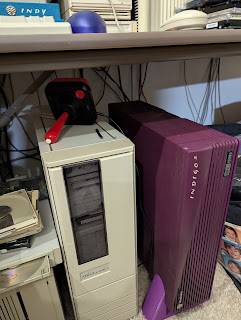 This beautiful purple slab is the Silicon Graphics Indigo² (though, unlike its earlier namesake, not actually indigo coloured) with the upper-tier MIPS R10000 CPU and IMPACT graphics. My recollection was that it worked at the time, but I couldn't remember if it booted, and of course that was no guarantee that it could still power on. If this machine is to stay working and in the collection, we're gonna need a Refurb Weekend.
Saturday, May 24, 2025
prior-art-dept.: The hierarchical hypermedia world of Hyper-G
Around this time, however, was when sites started referencing other sites, much like the expulsion from Eden. In 1990 both HYTELNET and Archie appeared, which were early search engines for Telnet and FTP resources. Since they relied on accurate information about sites they didn't control, both of them had to regularly update their databases. Gopher, when it emerged in 1991, consciously tried to be a friendlier FTP by presenting files and resources hung from a hierarchy of menus, which could even point to menus on other hosts. That meant you didn't have to locally mirror a service to point people at it, but if the referenced menu was relocated or removed, the link to it was broken and the reference's one-way nature meant there was no automated way to trace back and fix it. And then there was that new World Wide Web thing introduced to the public in 1993: a powerful soup of media and hypertext with links that could point to nearly anything, but they were unidirectional as well, and the sheer number even in modest documents could quickly overwhelm users in a rapidly expanding environment. Not for nothing was the term "linkrot" first attested around 1996, as well as how disoriented a user might get following even perfectly valid links down a seemingly infinite rabbithole.
Subscribe to:
Posts (Atom)